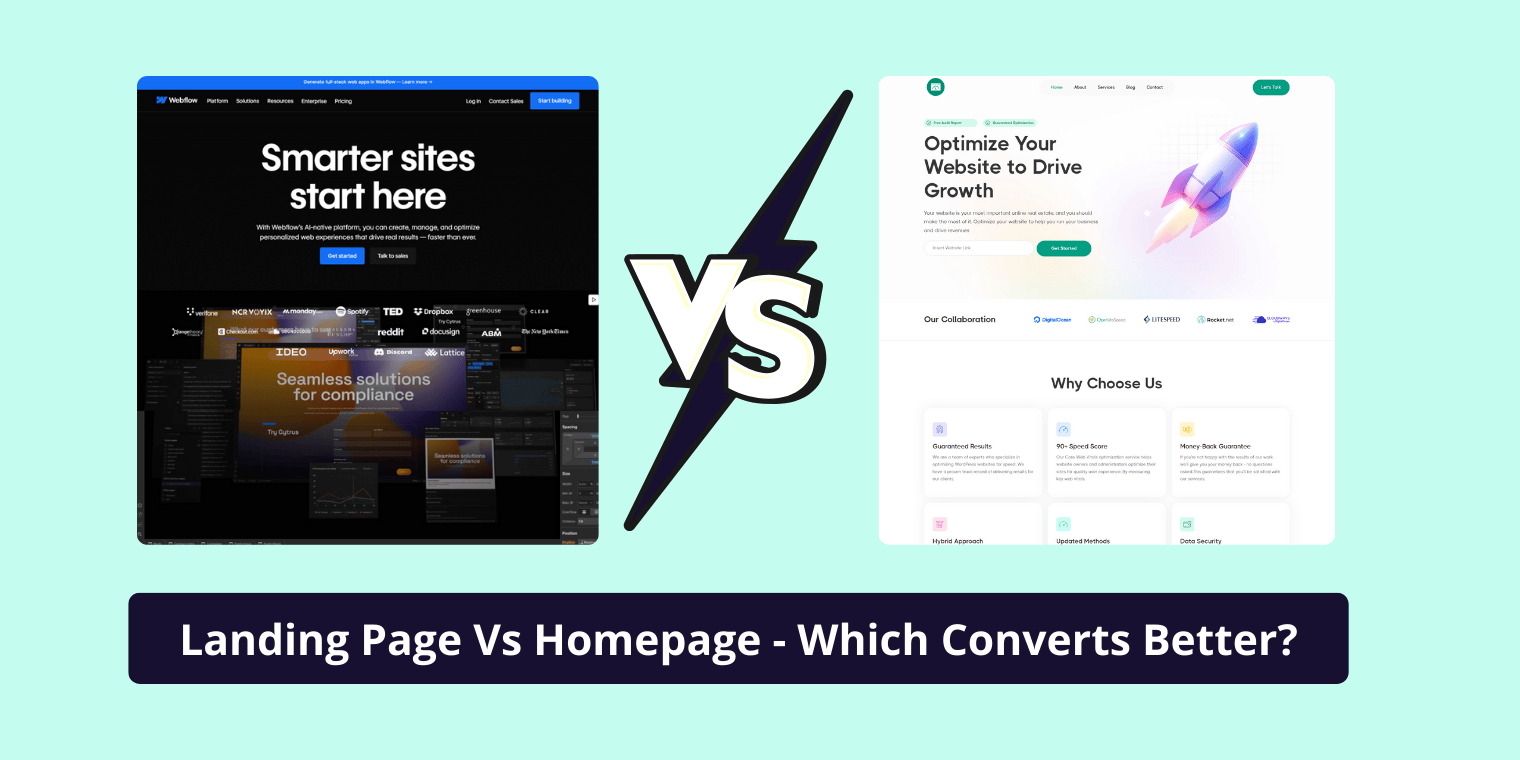
Choosing between a landing page and a homepage can be confusing, especially when you’re trying to improve conversions or run campaigns. Both pages look similar, but their purpose, structure, and results are completely different. This guide explains the difference in simple terms, when to use each, and how they impact SEO and conversions so you can send your traffic to the page that actually brings results.
Quick Comparison: Landing Page vs Homepage
Before we go deeper, here’s a simple snapshot of how they differ:
| Feature | Landing Page | Homepage |
|---|---|---|
| Main Goal | Convert visitors into leads/customers | Introduce brand and guide navigation |
| Audience | Specific campaign visitors | General visitors exploring your brand |
| Navigation | Minimal or no navigation | Full menu with multiple links |
| Use Case | Ads, campaigns, offers, signups | Brand authority, SEO visibility |
| Focus | One message + CTA | Multiple messages + multi-CTA |
Now let’s break each down clearly.
What Is a Landing Page?
A landing page is a focused, conversion-driven page created with one primary goal such as collecting leads, getting sign-ups, promoting a specific service, or selling a product. Unlike a homepage, a landing page isn’t trying to show everything your business offers. Instead, it removes distractions and pushes the visitor toward one action.
A good landing page has a clear headline, a value proposition explaining why someone should take action, social proof (testimonials, stats, trust badges), and a compelling CTA something like Book a Demo, Get a Quote, Start Free Trial, or Download the Guide.
There are several types of landing pages:
- Lead Generation Landing Pages — built to capture emails or contact details.
- Click-Through Landing Pages — used before sending users to a checkout page.
- Sales Landing Pages — designed to sell a product or service directly.
- Event or Webinar Pages — built for registrations and attendance.
- PPC Landing Pages — paired with Google/Facebook ads for conversion campaigns.
When designed properly, landing pages often outperform homepages in conversion rates because they remove navigation clutter and guide a user down a single decision path. This is why advertisers almost always send paid traffic to landing pages, not homepages.
What Is a Homepage?
A homepage is the main entry point of your website and serves as your brand’s face on the internet. It’s where people go when they search your business name or find you organically. Unlike landing pages, homepages have broader content and present multiple navigation paths services, about page, blog, portfolio, pricing, contact, etc.
Its goal is not immediate conversion. Instead, it builds trust, explains who you are, and directs visitors to the right part of your site. Think of your homepage like the reception area of a company. It welcomes people, shows what you offer, and lets them choose where to go next.
Strong homepages include:
- A clear brand message above the fold
- Navigation menu linking to core inner pages
- Overview of services or products
- Visual identity (colors, branding, story)
- Testimonials and social proof
- Footer links, credibility indicators, and contact details
A homepage needs to balance branding and UX. It must help search engines understand your site structure, boost topical authority, and guide users based on intent. This makes it important for SEO something landing pages are not always built for.
Key Differences: Homepage vs Landing Page
Although they may look similar at first glance, the intent and user journey behind each page is fundamentally different.
Purpose
Homepages are informational. They answer Who are you? What do you offer? Where should I go next?
Landing pages are transactional. They answer Why should I take this action right now? What benefit do I get?
Audience
Homepages serve general visitors people learning about your brand or browsing.
Landing pages serve targeted visitors people coming through ads, social campaigns, email marketing, or specific keywords.
Navigation
Homepages contain menus, internal links, sections, and multiple exit routes.
Landing pages usually remove navigation to keep visitors focused.
Content Style
Homepages highlight multiple offerings. Landing pages highlight one solution or offer.
SEO vs CRO Focus
Homepages are important for SEO because they contribute to structure and authority.
Landing pages are built for CRO — Conversion Rate Optimization.
Both are necessary, but for different reasons. You wouldn’t use a hammer to screw in a nail, and you shouldn’t use a homepage for a paid campaign.
When to Use a Landing Page (Practical Scenarios)
Use a landing page when your goal is immediate action or conversion. Ideal scenarios include:
- Running paid ads for lead generation campaigns
- Promoting a special offer or discount
- Launching a new product or service
- Offering a free trial or demo
- Hosting webinars or workshops
- Capturing newsletter sign-ups or downloads
- A/B testing headlines, offers, or messaging
The more targeted the audience, the better a landing page performs. Send cold or paid traffic to your homepage and they’ll wander, click around, and leave. Send them to a well-built landing page and they’ll convert more often.
When to Use a Homepage
Homepages matter for credibility, discoverability, and brand positioning. You should rely on it when:
- You want to highlight your business identity and offerings
- Visitors are coming organically through search or branded keywords
- Users need to explore services before deciding
- You’re building authority and trust long-term
- You want to improve internal linking and site architecture
A homepage is not like a sales page it’s a brand hub. It is where people form their first impression. A homepage helps users understand your company’s voice, tone, and professionalism before deciding to contact you.
SEO & Conversion Impact: Which Performs Better?
Landing pages can rank in search results, but most of the time their strength comes from campaigns, funnels, and controlled traffic sources. Homepages, on the other hand, help search engines crawl and understand your website, making them crucial for organic SEO.
From a conversion standpoint, landing pages typically convert higher because they maintain focus. In many campaigns I’ve worked on, moving traffic from homepages to dedicated landing pages increased conversions anywhere between 25% to 300%, depending on the offer and CTA clarity.
Why such a big difference? Because a homepage gives users too many choices. A landing page gives them just one.
Best Practices for Building Landing Pages That Convert
If you’re building a landing page, focus on psychology more than design. People convert when the offer is appealing, risks are lowered, and the value is clear. A converting landing page should:
- Have one primary CTA and avoid multiple links
- Communicate benefits quickly above the fold
- Use social proof — testimonials, ratings, case studies
- Keep the design clean and distraction-free
- Use urgency, scarcity, or incentives (optional)
- Load fast and look perfect on mobile
- Be A/B tested regularly (headline, CTA, copy)
A landing page isn’t final until you’ve tested it. The version you launch is just version one.
Best Practices for an Effective Homepage
A homepage needs to feel trustworthy, easy to navigate, and visually polished. It should answer questions fast because visitors decide whether to stay or leave within seconds. A strong homepage should:
- State who you are and what you offer clearly at the top
- Use a hero section that communicates value instantly
- Guide users with visible navigation and CTA buttons
- Highlight services/products without going too deep
- Feature testimonials or success proof
- Use visuals that represent quality and brand identity
- Include internal links for SEO and UX
Think of your homepage as a map. Present clear paths so users don’t guess where to go next.
Common Mistakes to Avoid
One of the biggest mistakes businesses make is using their homepage as the landing page for ads. This almost always leads to poor conversions. Other frequent mistakes include:
- Cramming too much content into landing pages
- Not explaining benefits clearly — only features
- Using weak generic CTAs like “Submit”
- No trust elements or proof
- Sending one page to all traffic sources
- Ignoring mobile experience
- Not testing variants
Sometimes even small tweaks like changing headline tone or button placement can double conversions.
Final Thoughts: So Which One Should You Use?
Both pages matter. A homepage builds trust, authority, and brand recognition. A landing page generates leads, sign-ups, and sales. The smart approach isn’t choosing one over the other it’s using them together strategically.
Use a homepage to express who your brand is.
Use a landing page to convert intent into action.
If you want the safest strategy for growth, start with a strong homepage for SEO + several landing pages for services, offers, and campaigns. This gives you the best of both visibility and conversions.
FAQ’S
1. What is the difference between a landing page and a homepage?
A landing page is designed for one specific goal usually conversions like leads or sales with minimal distractions and a single CTA. A homepage is a broad hub that introduces your brand, includes navigation, and guides users to different pages. Landing pages convert, homepages inform.
2. When should I use a landing page instead of a homepage?
Use a landing page when you want visitors to take a direct action, such as signing up, requesting a quote, downloading a resource, or responding to ads. It’s ideal for marketing campaigns where the goal is conversions. Homepages are better for general brand awareness and navigation.
3. Which converts better — landing page or homepage?
Landing pages typically convert better because they focus on a single message with no navigation distractions. They guide visitors toward one specific CTA, improving conversion rates significantly. Homepages support exploration and brand identity but aren’t as effective for direct conversions.
4. Can a landing page rank for SEO?
Yes, a landing page can rank organically if it’s optimized for keywords, offers valuable content, and has internal links. However, many landing pages are used for paid campaigns and may not be indexed. SEO landing pages should be content-rich, user-focused, and answer search intent clearly.
5. Can I use a landing page as my homepage?
You can use a landing page as a homepage, but it only works well for single-offer brands or short-term campaigns. Most businesses need a homepage to showcase services, navigation, and trust elements. Using both strategically delivers the best results homepage for branding, landing page for conversions.